DNS Breathing Training
Why Your Diaphragm Does More Than You Think
Most people think of the diaphragm as a breathing muscle — and it is. But it also has a second, less well-known function: it's a key muscle for core stability (spine stability).
In Dynamic Neuromuscular Stabilization (DNS), this dual role of the diaphragm is central. When it works well, breathing and stability happen together, automatically. When it doesn't, one function tends to suffer — and that's often where problems begin.
Book a One-on-One Session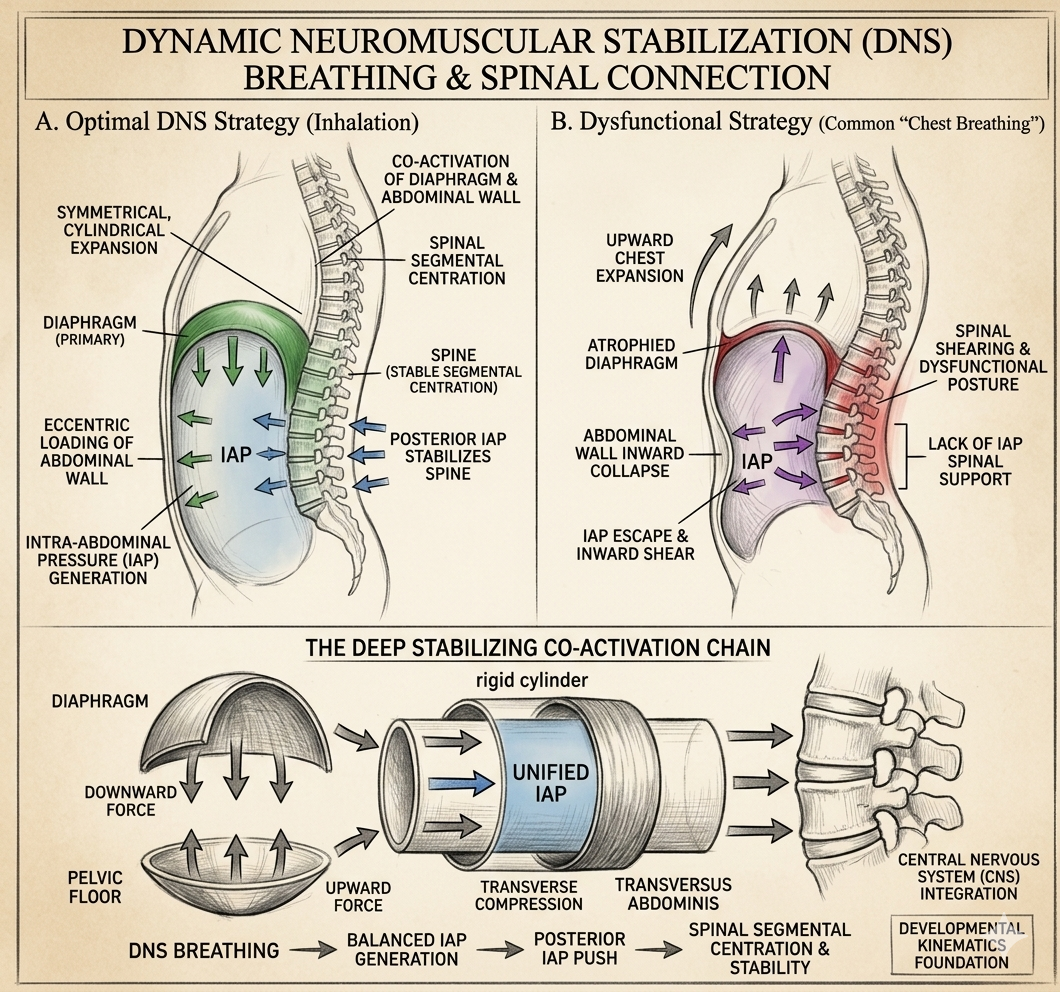
Two Jobs, One Muscle
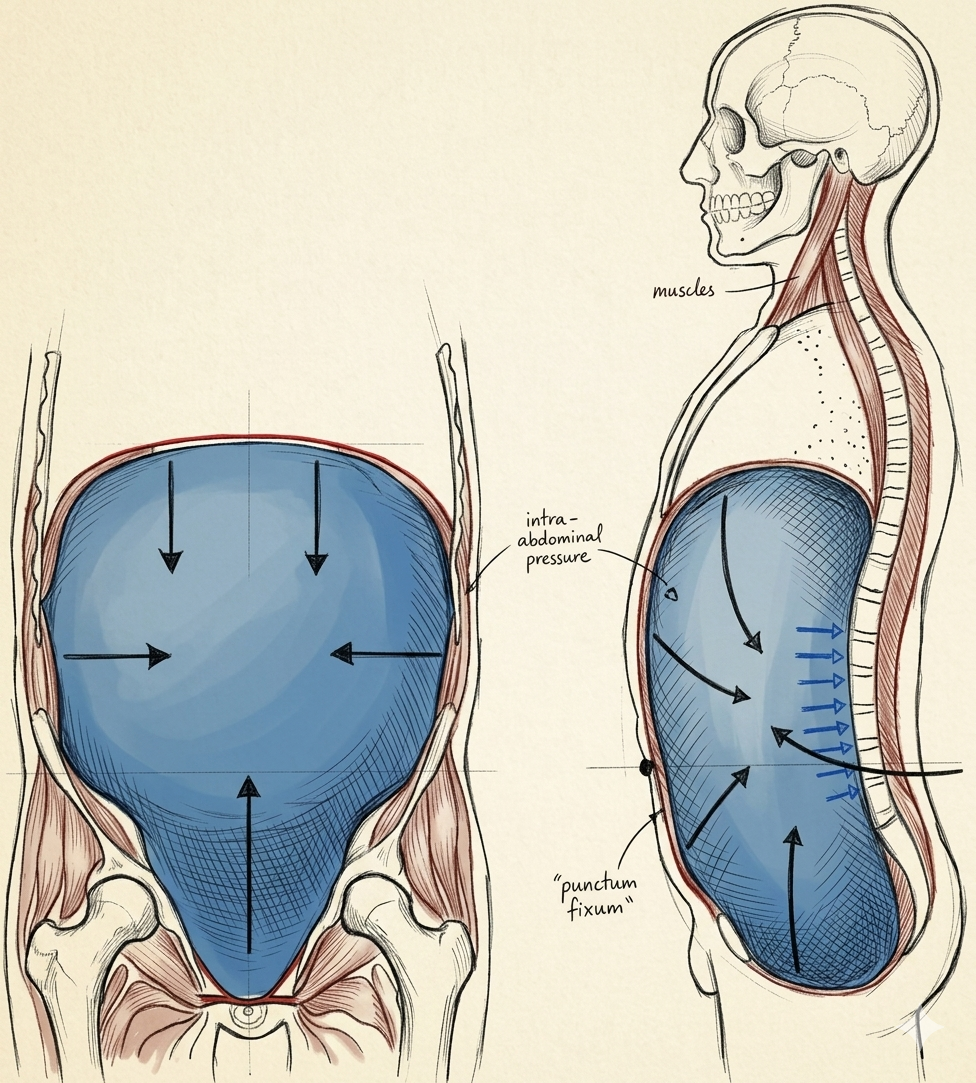
When you inhale, the diaphragm descends. If it descends properly — not just in the front, but in all directions — it creates pressure inside the abdominal cavity. This is called intra-abdominal pressure (IAP).
That pressure does something important: it activates the space around your spine. At the same time, it triggers the pelvic floor and deep abdominal wall to co-activate. Together, these muscles form a cylinder of support around the trunk.
This isn't something you have to think about. In a well-functioning system, it happens automatically before you move — before you reach, step, lift, or twist. Your nervous system does it for you. The problem is that for many people, it stops working this way.
How It Gets Disrupted
There are a number of reasons the diaphragm's stabilization function can become compromised:
Pain
Breathing patterns often shift due to the pain, and they don't always return to normal after the pain resolves.
Stress and anxiety
Tend to shift breathing toward the upper chest. The diaphragm still moves, but less effectively.
Poor posture
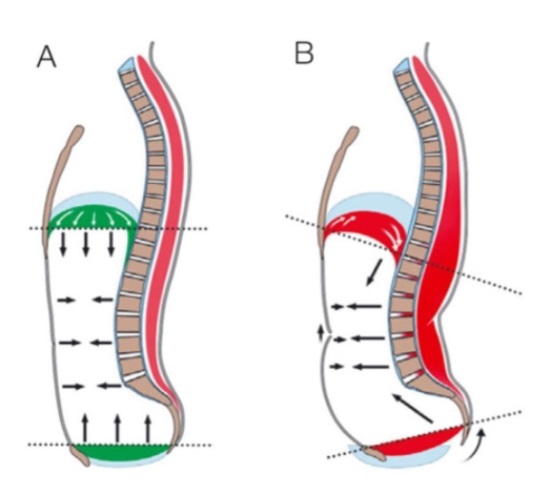
For example, a slouched posture pushes the ribcage down toward the pelvis, limiting the diaphragm's ability to descend fully. Over time, the nervous system adapts to a shallower, chest-dominant pattern.
Habitual chest breathing
Some people have simply been breathing this way for so long that their nervous system treats it as the default.
The result is the same in each case: the diaphragm does its breathing job (you're still alive, after all), but its stabilization function is reduced. Other muscles have to compensate — and they're often not well-suited for the task long-term.
What "Correct" Breathing Looks Like
When the diaphragm works correctly, contracting downwards, you should see expansion in all directions: front, sides, and back of the lower ribcage and abdomen. This is sometimes called 360-degree expansion. It's not about pushing your belly out — that's a common misconception. It's about even pressure distribution.
A useful way to think about it: imagine the trunk as a cylinder. When you breathe in, the entire cylinder should expand slightly — not just the front wall.
When this works well, the intra-abdominal pressure it generates supports the spine from the inside, in balance with your back muscles.
Why This Matters
There's solid clinical evidence linking diaphragm dysfunction to lower back pain. People who have difficulty using the diaphragm for both breathing and stabilization simultaneously tend to have higher rates of back problems.
This also matters for performance. If your core doesn't activate automatically before you move, force gets lost. Your limbs work harder than they need to, and the load ends up in structures that aren't designed to carry it repeatedly.
For some people, correcting the breathing pattern can have a noticeable effect relatively quickly. For others, it's one piece of a larger puzzle. But it's almost always worth investigating if you have persistent stability or pain issues.
The Gap Between Understanding and Doing
Here's the honest part: understanding how breathing works and actually retraining the pattern are two different things.
Some people can read about it, try it, and feel the difference immediately. Others find it surprisingly difficult to change a pattern they've used for years — especially because the diaphragm operates largely below conscious awareness.
The challenge is that you can think you're doing it correctly while your nervous system is still running the old pattern. It's a bit like trying to correct your own posture in a mirror — you can get close, but you might miss what you can't see.
This is why DNS practitioners often use hands-on cues — physically guiding the ribcage or abdomen so you can feel what correct expansion actually feels like. Once you've felt it, it becomes much easier to reproduce.
If You Want to Explore This Further
If you're curious about whether your breathing pattern might be affecting your stability or contributing to a pain issue, a single session can often clarify that. Eva assesses how your diaphragm is functioning in different positions and can tell you fairly quickly whether this is a relevant factor for you.
No commitment beyond that — some people need ongoing work, others just need a few corrections and some exercises to practice at home.
Book a SessionOr email us at info@dnstrainer.com
Book Your DNS Training Session
Take the first step towards better movement, improved posture, and enhanced performance. Experience personalized coaching tailored to your unique needs.
Schedule Your Session NowOr email us at info@dnstrainer.com