DNS and Core Stability
Core Stability: It's Not About How Strong Your Core Is
You've probably been training your core — there's no shortage of exercises out there. And they're not bad exercises. But here's something that often gets lost in the conversation: core stability isn't really about how strong those muscles are. It's about when and how they activate.
Book a One-on-One DNS Assessment
Strength and Stability Are Not the Same Thing
This is the part that surprises most people. You can have very strong core muscles and still have poor core stability. Research has shown that the difference between backs that function well and backs that don't often comes down to timing — about 20 milliseconds of difference in when the deep stabilizers fire relative to movement.
That's not a strength issue. It's a motor control issue — the nervous system isn't organizing the sequence correctly.
Your "deep stabilizing muscles" (the diaphragm, the deep abdominal wall, the pelvic floor as a system) are supposed to activate automatically, a fraction of a second before you move. Before you reach, step, lift, or twist. This is called feed-forward activation — your brain anticipates the movement and pre-stiffens the trunk to create a stable base.
When this works well, it's invisible. You don't feel it happening. When it doesn't work well, other muscles compensate — and over time, that can lead to overload, stiffness, or pain in areas that are picking up the slack.
Why Exercises Can Look Right but Miss the Point
Here's a common scenario: someone does a dead bug with good form. Their spine stays neutral, their legs move smoothly, it looks correct from the outside. But their deep stabilizing system may not actually be doing the work — the superficial muscles (rectus abdominis, external obliques) might be carrying the load instead.
The exercise gets done. It even feels hard. But the pattern underneath — how the nervous system organizes the stabilization — hasn't necessarily changed.
This isn't a problem with the exercise itself. It's a problem with what's happening at the level of motor control. And it's very difficult to detect on your own, because the compensatory pattern feels normal to you — it's been your default for years.
The Hollowing vs. Bracing Question
If you've looked into core training at all, you've probably encountered conflicting advice. "Draw your navel in toward your spine." "No — brace like you're about to be punched." Both cues get taught confidently. Both have research supporting them. It's confusing.
The DNS perspective is different from both. It doesn't start with a conscious cue at all. The goal is to restore the automatic activation that should be happening before you even think about it.
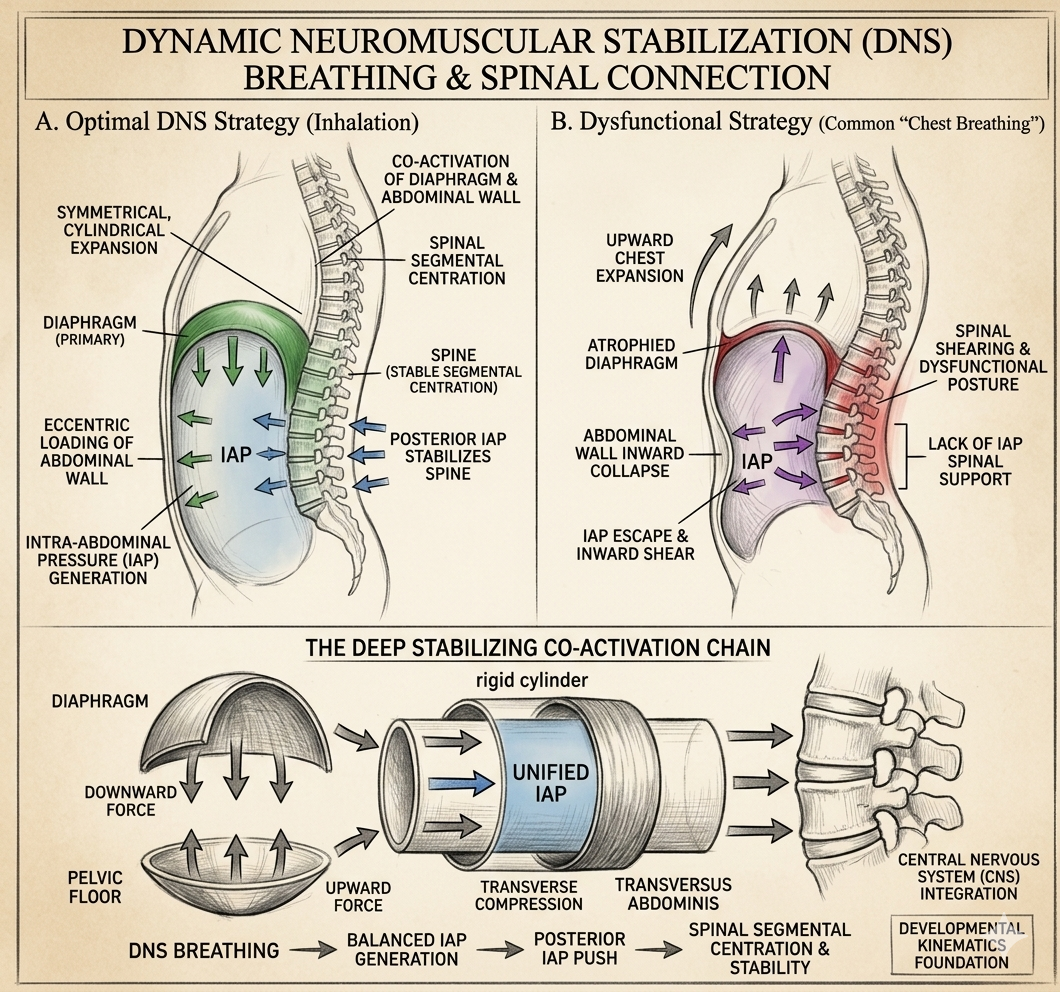
In a well-functioning system, you don't need to hollow or brace — the intra-abdominal pressure regulation happens on its own, driven by the diaphragm descending and the deep muscles co-activating in response. It's not something you consciously manage. It's something your nervous system does for you — if the pattern is intact.
What DNS Adds to the Picture
Dynamic Neuromuscular Stabilization looks at core stability as a nervous system issue, not a muscle strength issue.
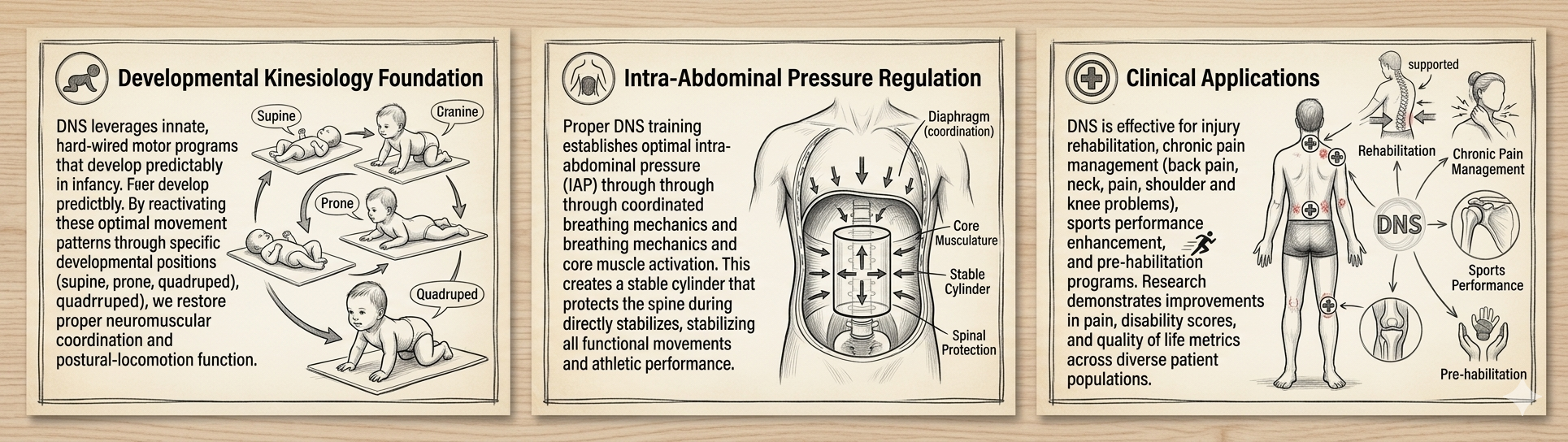
The approach is based on a simple observation: every healthy infant develops perfect core stabilization automatically during the first year of life — without being taught, without exercises, without cues. The nervous system matures and the stabilization patterns emerge in a predictable sequence.
Those patterns are still in your nervous system. But for many adults, they've been "overridden" — by injuries, prolonged sitting, habitual movement patterns, or training that emphasized strength without addressing coordination.
DNS uses developmental positions (positions we all moved through as infants) to re-access these patterns. The exercises look deceptively simple. But the goal isn't to "work" the muscles — it's to change how your nervous system organizes the stabilization.
What This Looks Like in Practice
In a session, Eva assesses how your stabilizing system is actually functioning — not how strong it is, but how it's coordinating.
Timing and sequencing
Are your deep stabilizers activating before movement begins, or is the superficial system doing all the work?
Breathing and stabilization together
Can your diaphragm do both jobs simultaneously? Many people lose stabilization the moment they need to breathe under effort. See DNS breathing training.
Real-time feedback
Eva uses manual and visual cues to help your nervous system find the correct pattern. The difference between "doing the exercise" and "activating the system" is often subtle — sometimes it takes hands-on guidance to feel what correct activation actually is.
The training itself is initially slow and simple. The point is to establish correct motor patterns at low load, then gradually build complexity. Typically 10–15 minutes of daily practice is needed until the pattern becomes automatic. Learn more about DNS breathing training.
Who This Is Relevant For
This applies broadly — whether your interest is resolving pain, improving athletic performance, or just understanding why your core training isn't translating into the stability you'd expect.
Some signs that motor control might be part of your picture:
- •You train your core regularly but still feel unstable or get recurring pain
- •You can plank for minutes but your back still bothers you
- •You've been told you have a "weak core" despite being strong
- •Your stability disappears under fatigue or when you add speed
These aren't diagnostic — but they're the kind of situation where looking at how the system is coordinating, not just whether it's strong enough, can sometimes reveal something useful.
Want to Find Out What's Actually Happening?
If you're curious whether your core is stabilizing effectively — not just working hard — a single session can often clarify that. Eva can assess your timing, your breathing pattern, and how your deep system is coordinating, and tell you what's actually going on underneath the exercises you're already doing.
Book a SessionOr email us at info@dnstrainer.com